
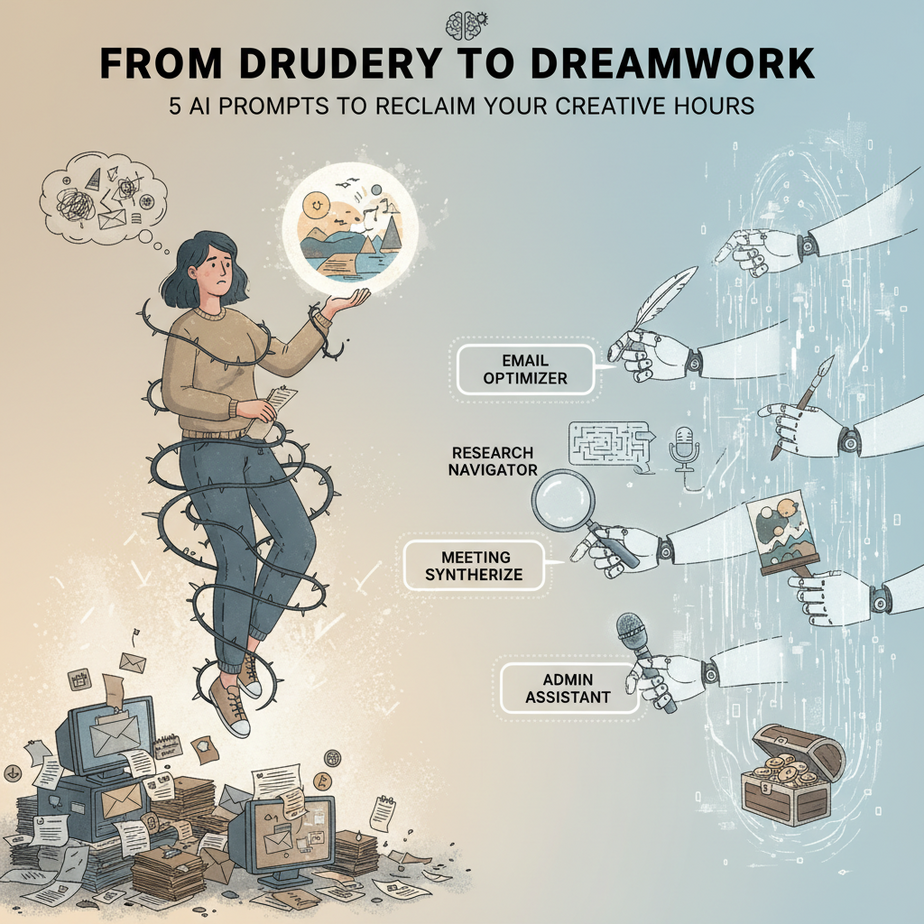
Every creator knows the feeling: a mind buzzing with brilliant ideas, held captive by a mountain of administrative quicksand. The emails, the meeting notes, the research rabbit holes—they are the silent thieves of creative energy, draining our best hours and leaving us too exhausted for the deep, focused work that truly matters. The promise of AI isn’t to replace our creative spark, but to act as a tireless assistant, clearing away this procedural undergrowth. By strategically using tools like ChatGPT, we can shift our daily balance, offloading the mundane tasks that bog us down and liberating ourselves to spend more time innovating, imagining, and actually creating.
The first front in the war against busywork is communication and organization. Instead of rereading a labyrinthine email chain for the tenth time, try this prompt: “Summarize the key decisions and outstanding action items from the following email thread, listing who is responsible for each.” This transforms chaos into clarity. Similarly, after a brainstorming session, feed your raw notes or a transcript to the AI with the command: “Act as a project manager. Synthesize these meeting notes into a concise summary, a list of actionable next steps, and potential project risks.” This isn’t just about saving time; it’s about preserving the mental momentum generated in the meeting, converting scattered thoughts into a structured plan without the cognitive drain.
Next, let’s tackle the foundational stages of any creative project: research and ideation. Generic Google searches often yield generic results. Instead, frame a more powerful prompt: “Assume the role of a market research analyst. Provide a bulleted list of the top 5 emerging consumer trends in the sustainable fashion industry, including a brief analysis of the opportunity each presents.” This positions the AI as a specialist, delivering curated insights that provide a solid foundation for creative strategy. To break through a creative block, use it as a catalyst for divergent thinking: “Generate 10 unconventional metaphors to describe the concept of ‘digital privacy,’ avoiding common clichés like ‘fortress’ or ‘shield’.” The goal here isn’t to use the AI’s ideas verbatim, but to use them as a springboard to jolt your own thinking onto a more original path.
Once you’ve created something brilliant, the administrative work isn’t over; you have to share it with the world. This is where AI can become your personal content marketing assistant. Take a finished piece, like a long-form article, and use a prompt like this: “Repurpose the key arguments from the article below into a 5-tweet thread, a compelling LinkedIn post, and three talking points for a short video script.” This single action multiplies the impact of your core creative work by efficiently adapting it for different platforms. It automates the often tedious task of reformatting and allows you, the creator, to move on to the next project while your AI assistant handles the promotional heavy lifting.
Ultimately, integrating these prompts into your workflow is less about technology and more about a fundamental mindset shift. It’s about recognizing that your creative energy is your most valuable and finite resource. By delegating the repetitive, formulaic, and administrative tasks to an AI collaborator, you are not diminishing your own role—you are elevating it. You are consciously choosing to spend your time on problem-solving, storytelling, and innovation, the very things that only a human can do. This transforms you from an overwhelmed administrator of your own career into a focused architect of your creative vision, freeing you to do the work that truly fulfills you.