
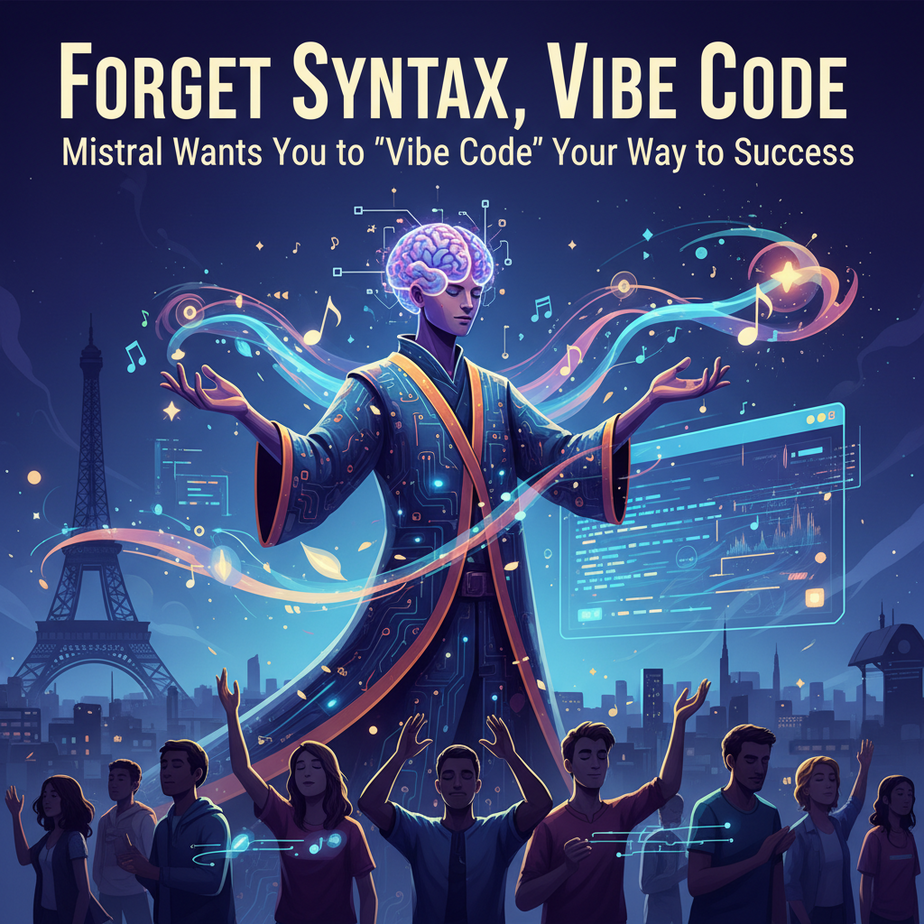
In the ever-escalating arms race for AI supremacy, the battleground for developers’ terminals is getting fierce. Paris-based powerhouse Mistral, now boasting a staggering valuation, has just deployed its latest strategic assets: Devstral 2, a new family of open-weight coding models, and a clever command-line agent. This isn’t just another incremental update in a world saturated with code assistants. Instead, it feels like a deliberate attempt to shift the very nature of developer-AI interaction from a rigid, command-based relationship to something more intuitive, a collaborative process one might call “vibe coding.” Mistral is betting that the future isn’t just about autocompleting lines, but about understanding a project’s soul.
So, what exactly is “vibe coding?” It’s the idea that an AI partner should grasp the developer’s intent, architectural style, and overall project goals without needing painfully explicit instructions for every single task. It’s the difference between a tool that just fills in the blanks and a collaborator that anticipates your next move because it understands the bigger picture. This approach promises to alleviate significant cognitive load, freeing developers to focus on complex problem-solving and creative architecture while the AI handles the granular implementation, all while maintaining the established “vibe” of the existing codebase. It’s a subtle but profound shift from mere code generation to genuine software craftsmanship augmented by machine intelligence.
The engines driving this new philosophy are Devstral 2 and its companion CLI agent. By releasing these models with open weights, Mistral throws down a gauntlet to its more closed-off competitors. This strategy is a direct appeal to enterprise clients and developers who prioritize transparency, customization, and the ability to run powerful models on their own infrastructure for security and control. The accompanying CLI agent, Codestral.ai, smartly integrates this power directly into the command line—the native environment for so many developers. This isn’t a flashy UI or a clunky plugin; it’s a tool designed to seamlessly weave itself into the existing, keyboard-driven workflows that professionals rely on daily.
This dual launch is a calculated and strategic strike against the incumbents like GitHub Copilot and Google’s Gemini. Mistral is carving out a distinct identity by championing openness in a field increasingly dominated by proprietary systems. The company understands that many developers are inherently skeptical of black-box solutions and crave more control over their toolsets. By combining a powerful, open-weight model with a practical, developer-first interface, Mistral is not just competing on performance; it’s competing on ethos. It’s a direct appeal to the open-source community and the enterprise sector’s growing demand for auditable and adaptable AI solutions.
Ultimately, Mistral’s latest move pushes us to consider the future trajectory of software development. We are moving beyond tools that simply write code and toward systems that act as true creative partners. The concept of “vibe coding” may sound whimsical, but it points to a future where the friction between a developer’s idea and its execution is minimized to near zero. This isn’t about replacing human developers, but about augmenting their intuition and elevating their craft. Mistral is proposing a new pact between coder and code, one built not on rigid syntax and commands, but on a shared understanding and a collaborative rhythm that could redefine how we build the digital world.